Buses arrive in Taajama
Where it all begins
We wanted public transport to be something the player builds from scratch. It doesn't appear in the city automatically – it only unlocks once the city has at least 200 residents.
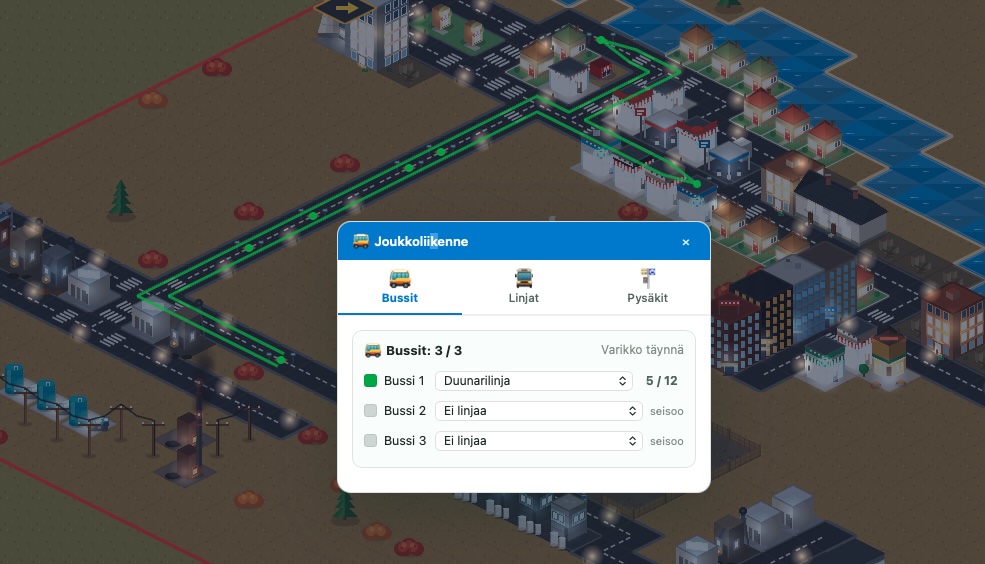
The first step is to build a bus depot.
The depot acts as the home for your buses, but we also wanted to avoid a situation where the player builds an expensive building and immediately needs more money just for the first bus. That's why every new depot comes with one bus thrown in.
Free buses don't keep falling from the sky, though. A depot holds three buses, and the rest you have to acquire yourself.
The routes are exactly what you make them
One thing was clear from the start: we didn't want ready-made bus routes.
Instead, the player decides where the bus stops go.
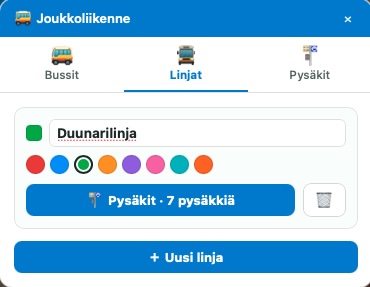
A road turns into a bus stop with a single click, and back into an ordinary road just as easily. After that you give the route a name and a colour, and click the stops onto the map in whatever order you like.
Every bus has its own route, so several completely different bus lines can run across the city at the same time. A little bus looping the centre, a line connecting the suburbs, or even a direct link to the industrial area – all of them work.
And if you design the worst bus route in the world, the game won't argue. The townsfolk will let you know their opinion one way or another, though.
We wanted the buses to feel real
Perhaps the most time went into making sure the buses don't just "move" people from A to B.
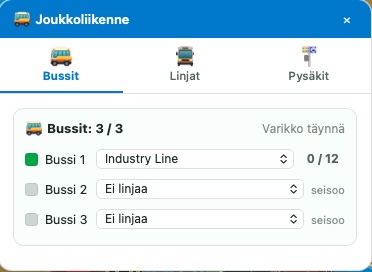
Residents genuinely walk to the stop, wait for the bus, board only once it arrives, ride along and get off at the right stop. After that the journey continues on foot.
You can see all of this on the map.
The buses' capacity is real too. If a bus is full, not everyone fits in. Some are then left waiting for the next service... or decide that their own car was a pretty good invention after all.
Routes can also be changed mid-game. Buses don't teleport back to the depot – they carry on from where they are and ease onto the new route naturally.
The ride's on the city
Another small design decision concerned tickets.
There aren't any – at least not yet.
Townsfolk travel by bus for free, with no need to worry about travel cards or ticket machines. The city picks up the tab.
How long will this last? Let's just say the city's finances are bound to come up again at some point.
Small changes, big impact
One of the most enjoyable things about building this whole feature was watching what happens to the city when the first working bus route opens.
Suddenly not everyone sets off in their own car. Traffic jams start to ease, the roads flow better, and the city simply looks more alive as buses circle the streets and residents head for the stops.
It's exactly these chain reactions that make Taajama interesting to build. A single new feature is never just a single new feature – it gradually starts to affect everything around it.
What's next?
Public transport is now in the game, but it feels more like a starting point than a finished feature.
There's already a long list of ideas for what comes next, so we'll definitely be coming back to buses later.
Until then, it's worth experimenting with different bus routes. Sometimes a single new connection is enough to clear the entire morning rush.
And sometimes you realise you've built a route travelled by exactly one pensioner and three students.
That, too, is surprisingly realistic.